Guide for bidders
Bid security: how much, in what form, and when it comes back
Checked against the official sources on 18 Nov 2026 · PakistanTenders.pk
What bid security is
Bid security, also called earnest money, an EMD (earnest money deposit) or a bid bond, is money a bidder deposits with its bid to show it is serious. If the bidder withdraws during the bid's validity or wins and then refuses to sign the contract, the agency keeps it; otherwise it is returned. Notices print it as a percentage of the estimated cost or of the bid, or as a fixed sum, and in Urdu as زرِ ضمانت.
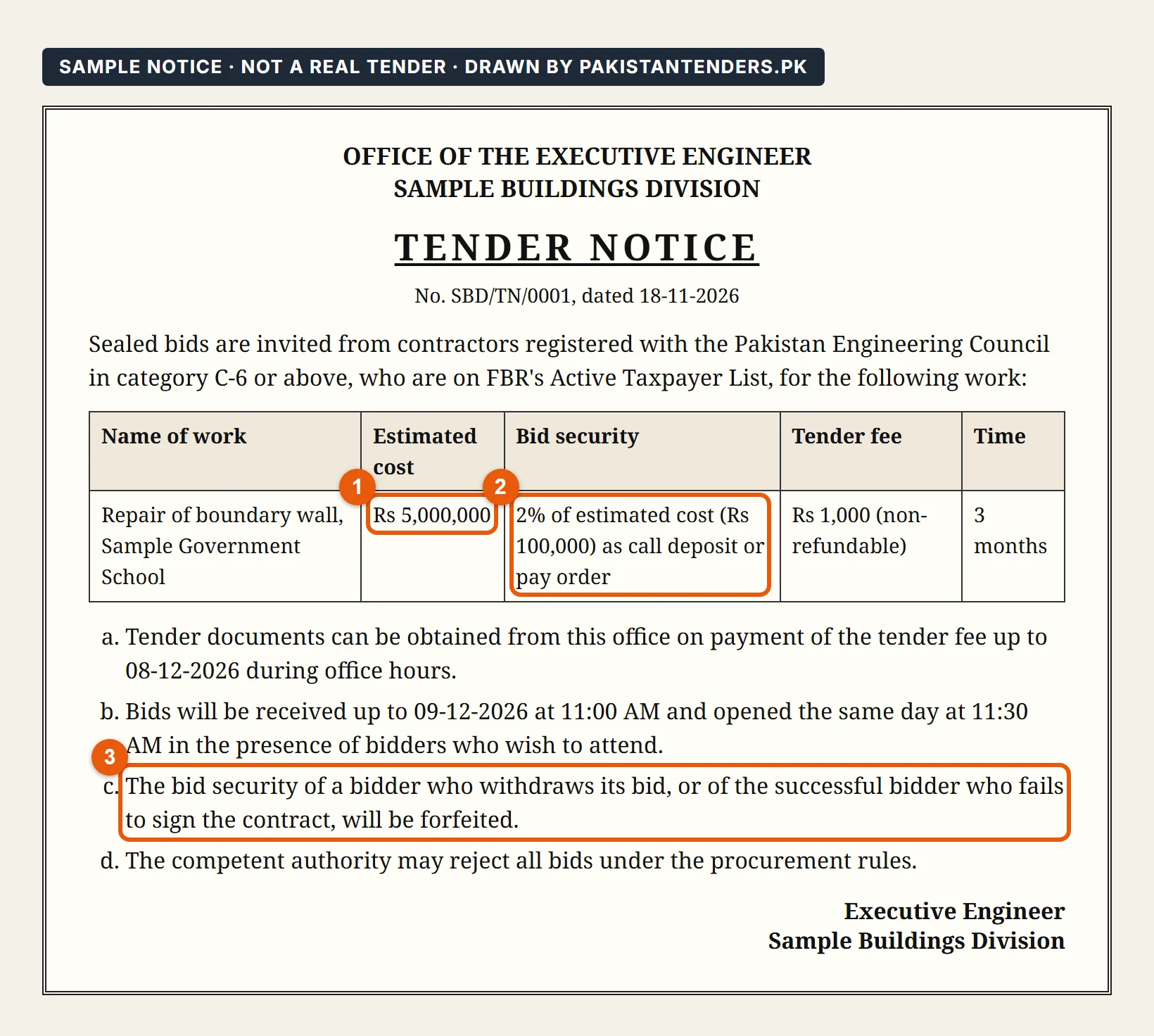
- The estimated cost: the base a percentage is worked out from.
- The bid security: an amount or a percentage, and the forms accepted (here a call deposit or pay order).
- When it is forfeited.
A made-up notice drawn by PakistanTenders.pk to show where these details are printed. The office, work, amounts and dates are invented.
How much: each government's limit
| Rules | Limit | Of |
|---|---|---|
| Federal, Public Procurement Rules 2026, Rule 36 | Up to 5% for procurements up to Rs 250 million; up to 2% above Rs 250 million. Optional: where none is asked, a bid-securing declaration. | The estimated value set by the agency |
| Punjab, Punjab Procurement Rules 2014, Rule 27 | Up to 5%. Optional ("may require"). | The estimated price |
| Sindh, Sindh Public Procurement Rules 2010, Rule 37 (as amended in August 2025) | A fixed amount of up to 5%. Required ("shall require"). | The estimated value set by the agency |
| Khyber Pakhtunkhwa, KP Rules 2014, Rules 12 and 20 | Goods: up to 2% if required, or up to 5% for complex procurements. Works: 2%, required ("shall"). | Not stated in the rules; KP bidding documents use the estimated cost, or a lump sum |
| Balochistan, BPPR 2014, Rule 29 | 2%; between 2% and 5% for complex procurements. Optional ("may require"). | Not stated in the rule; BPPRA's sample notice says the total amount of the tender |
The notice, and the bidding documents behind it, set the actual amount for each tender. Under the federal rules, procurements that started before 28 September 2026 continue under the 2004 rules.
What notices ask for
Bid security in notices on this site
Of the 2,146 tender notices on this site, 860 give the bid security as a percentage and 539 as a fixed amount. The commonest percentages are 2% (430 notices), 5% (325 notices), 3% (70 notices), 1% (25 notices) and 2.5% (4 notices).
Counted live from the notices on file; auctions, whose earnest money follows different rules, left out. Each notice page shows its own bid security.
Accepted forms
The rules mostly leave the form to the bidding documents; the federal rules only require the documents to give the format of every security. In practice notices ask for one of these, issued by a scheduled bank:
- Call deposit receipt (CDR), also "deposit at call"; Balochistan's rule names it with the bank guarantee.
- Pay order or demand draft.
- Bank guarantee, valid beyond the bid's validity; Sindh's Rule 37 asks for 28 days beyond it.
Sindh's Rule 37 names deposit at call, pay order, demand draft or bank guarantee from a scheduled bank (or a foreign bank counter-guaranteed by one), in favour of the procuring agency, and the agency must have it verified by the issuing bank. PPRA Punjab's FAQ lists bank guarantee, bank draft, pay order and CDR as acceptable, and says postal drafts and insurance guarantees cannot be accepted because a scheduled bank does not issue them. Make the instrument out to the officer the notice names, for the exact amount or percentage.
Bid-securing declaration
Under the federal 2026 rules, an agency that does not ask for bid security has bidders submit a bid-securing declaration instead, in the format of PPRA's standard bidding documents (Rule 36), and gallop tenders for Rs 0.7 million to 2 million always use one (Rule 31). It is a written undertaking in place of money: a bidder who breaks it, for example by withdrawing its bid, can be blacklisted for up to six months (Rule 25).
Bid security on e-PADS
The rules do not say how a paper instrument goes with an electronic bid; the bidding documents do. In the federal and Punjab tenders we read, the bidder uploads a scanned copy with the e-bid and delivers the original to the procuring agency before the closing time, or before bids are opened. A bid without both can be rejected, so check the notice for the address and the time. Punjab's e-procurement system also takes bid security payments through 1-Link, according to the province's announcement in July 2026.
Refund and forfeiture
When it comes back:
- Sindh: to unsuccessful bidders within seven days of the contract being signed or the validity period expiring, and within 15 days if the bidding is cancelled (Rule 37(4) and (6)).
- Khyber Pakhtunkhwa: to unsuccessful bidders after the contract is signed (Rule 20(3)). On works, the winner's 2% is kept, and where a performance guarantee is needed the winner adds a bank guarantee of 8% of the contract cost (Rule 20(4)).
- Balochistan: to technically non-responsive bidders within 30 days of their bids being declared non-responsive; other unsuccessful bidders' security is not kept beyond 30 days of the award (Rule 29).
- Federal and Punjab: the rules leave it to the bidding documents. Federal documents discharge the winner's bid security once it furnishes the performance security.
When it is forfeited (Sindh Rule 37(5), KP Rule 35(4), Balochistan Rule 29(5), and the federal bidding documents):
- the bidder withdraws its bid after opening, within the validity period;
- the successful bidder fails to sign the contract or to furnish the performance security;
- in Sindh and Balochistan, the bidder does not accept the correction of arithmetic errors in its quoted amount; in Sindh, also a bidder found blacklisted by a federal or provincial agency.
Refusing a validity extension is not a reason to forfeit it. Under the federal Rule 37, Punjab's Rule 28 and KP's Rule 35, a bidder who will not extend may withdraw its bid without forfeiture; a federal bidder who agrees must extend its bid security too.
Performance security
Separate from bid security, the winner may have to furnish a performance security before signing, to guarantee the contract. The federal rules cap it at 10% of the contract amount and require it only where the bidding documents say so (Rule 51). Punjab caps it at 10% of the contract amount (Rule 56) and KP at 10% of the bid value (Rule 21). Sindh requires it in all open competitive bidding, up to 10% of the contract price, valid through any defects liability or maintenance period (Rule 39).
Questions bidders ask
How much bid security can a federal agency ask for?
Up to 5% of the estimated value for procurements up to Rs 250 million, and up to 2% above that (Rule 36 of the Public Procurement Rules, 2026). Where it asks for none, bidders submit a bid-securing declaration instead.
What is the bid security percentage in Punjab?
Up to 5% of the estimated price, under Rule 27 of the Punjab Procurement Rules, 2014. Each notice states the amount or percentage it requires.
Which forms of bid security are accepted?
Usually a call deposit receipt (CDR), pay order, demand draft or bank guarantee from a scheduled bank, as the notice says. PPRA Punjab says postal drafts and insurance guarantees are not accepted.
When is bid security returned?
To unsuccessful bidders once the contract is signed with the winner: in Sindh within seven days of that or of the validity expiring, in Balochistan no later than 30 days after the award. The winner's is released once it furnishes the performance security.
What is the bid security percentage in Sindh?
Since August 2025, Rule 37 of the Sindh Public Procurement Rules requires a fixed amount of bid security of up to 5% of the estimated value of the procurement, valid 28 days beyond the bid validity.
When is bid security forfeited?
When a bidder withdraws its bid after opening during the validity period, or the successful bidder fails to sign the contract or furnish the performance security. Refusing to extend the bid validity is not a reason to forfeit it.
What is the Urdu for bid security?
Notices print زرِ ضمانت (security money), بولی سیکیورٹی or ای ایم ڈی (EMD, earnest money deposit). See the Urdu tender terms guide.
Is bid security the same as performance security?
No. Bid security guarantees the bid and is returned. Performance security, usually up to 10% of the contract, is furnished by the winner to guarantee the contract.
Sources
Checked on 18 Nov 2026. The rules and the portals themselves are the authority; where a rule changes after that date, the change applies.
- Public Procurement Rules, 2026 (SRO 1658(I)/2026), Rules 25, 31, 36, 37 and 51
- Punjab Procurement Rules, 2014, amended to 24 September 2025, Rules 27, 28 and 56
- PPRA Punjab FAQs (bid security limit and accepted forms)
- Sindh Public Procurement Rules, 2010, amended to 2025 (Sindh Judicial Academy compilation), Rules 37 and 39
- KP Public Procurement of Goods, Works and Services Rules, 2014, amended to 17 August 2022, Rules 12, 20, 21 and 35
- Balochistan Public Procurement Rules, 2014, Rule 29
- PIDCL bidding document on e-PADS v2.0 (ITB 17.1, scanned and original bid security)
- Punjab Higher Education Department tender notice, 2026 (scanned and original bid security)
- APP, 2 July 2026: Punjab's e-procurement system with 1-Link bid security payment
PakistanTenders.pk is an independent site, not a government body or regulator. Spotted a mistake? Tell us.
